If You Had Lung Cancer What Are the Chances You Get It Again
On this page:
- Exposure to radon causes lung cancer in not-smokers and smokers akin
- Radon take a chance if you smoke
- Radon risk if y'all have never smoked
- Studies find straight evidence linking radon in homes to lung cancer
- Biological Furnishings of Ionizing Radiations (BEIR) VI Report: "The Health Effects of Exposure to Indoor Radon"
- 2003 EPA Assessment of Risks from Radon in Homes
- The U.S. Surgeon Full general issues national wellness advisory on radon
- World Health Organization's international radon project
- Radon-related lung cancer deaths compared to other select cancers
- Webinar: An Introduction to Radon Gas in Homes
Exposure to Radon Causes Lung Cancer In Non-smokers and Smokers Alike
The Facts...
- Lung cancer kills thousands of Americans every year. Smoking, radon, and secondhand fume are the leading causes of lung cancer. Although lung cancer tin be treated, the survival rate is one of the everyman for those with cancer. From the time of diagnosis, between xi and 15 percentage of those afflicted will alive across five years, depending upon demographic factors. In many cases lung cancer can exist prevented.
- Smoking is the leading crusade of lung cancer. Smoking causes an estimated 160,000* cancer deaths in the U.S. every year (American Cancer Club, 2004). And the rate amidst women is rising. On January 11, 1964, Dr. Luther L. Terry, then U.Due south. Surgeon General, issued the first warning on the link between smoking and lung cancer. Lung cancer now surpasses breast cancer equally the number i crusade of decease among women. A smoker who is too exposed to radon has a much higher hazard of lung cancer.
- Radon is the number i cause of lung cancer amongst non-smokers, according to EPA estimates. Overall, radon is the second leading cause of lung cancer. Radon is responsible for nigh 21,000 lung cancer deaths every year. About two,900 of these deaths occur amidst people who have never smoked. On Jan 13, 2005, Dr. Richard H. Carmona, the U.S. Surgeon General, issued a national wellness advisory on radon.
- World Wellness Arrangement's international radon project
- Secondhand smoke is the tertiary leading cause of lung cancer and responsible for an estimated 3,000 lung cancer deaths every year. Smoking affects non-smokers by exposing them to secondhand smoke. Exposure to secondhand smoke tin have serious consequences for children'south health, including asthma attacks, affecting the respiratory tract (bronchitis, pneumonia), and may crusade ear infections.
- For smokers the chance of lung cancer is significant due to the synergistic effects of radon and smoking. For this population almost 62 people in a ane,000 will dice of lung-cancer, compared to vii.3 people in a 1,000 for never smokers. Put another way, a person who never smoked (never smoker) who is exposed to one.3 pCi/L has a 2 in i,000 run a risk of lung cancer; while a smoker has a twenty in 1,000 chance of dying from lung cancer.
Radon Risk If You Smoke
from "A Citizen's Guide to Radon: The Guide to Protecting Yourself and Your Family unit From Radon"
| Radon Level | If 1,000 people who smoked were exposed to this level over a lifetime*... | The risk of cancer from radon exposure compares to**... | WHAT TO DO: Stop smoking and... |
|---|---|---|---|
| 20 pCi/L | About 260 people could become lung cancer | 250 times the chance of drowning | Fix your home |
| 10 pCi/Fifty | About 150 people could become lung cancer | 200 times the risk of dying in a home fire | Set up your home |
| 8 pCi/L | Near 120 people could get lung cancer | 30 times the risk of dying in a autumn | Prepare your home |
| 4 pCi/L | About 62 people could get lung cancer | 5 times the adventure of dying in a car crash | Ready your home |
| ii pCi/L | About 32 people could get lung cancer | 6 times the risk of dying from poisonous substance | Consider fixing betwixt ii and 4 pCi/Fifty |
| 1.3 pCi/L | Well-nigh xx people could get lung cancer | (Boilerplate indoor radon level) | (Reducing radon levels below two pCi/Fifty is hard.) |
| 0.4 pCi/50 | About 3 people could become lung cancer | (Average outdoor radon level) | |
| Note: If you are a former smoker, your risk may exist lower. * Lifetime risk of lung cancer deaths from EPA Assessment of Risks from Radon in Homes (EPA 402-R-03-003). ** Comparing data calculated using the Centers for Disease Control and Prevention's 1999-2001 National Center for Injury Prevention and Command Reports. | |||
Radon Take chances If Y'all Accept Never Smoked
| Radon Level | If 1,000 people who never smoked were exposed to this level over a lifetime*... | The take a chance of cancer from radon exposure compares to**... | WHAT TO Practise: |
|---|---|---|---|
| twenty pCi/L | Nigh 36 people could get lung cancer | 35 times the risk of drowning | Fix your home |
| x pCi/L | About 18 people could become lung cancer | xx times the chance of dying in a home fire | Gear up your home |
| eight pCi/L | About fifteen people could go lung cancer | 4 times the run a risk of dying in a fall | Fix your home |
| 4 pCi/L | Most seven people could become lung cancer | The risk of dying in a car crash | Set your home |
| ii pCi/L | About 4 person could become lung cancer | The risk of dying from poison | Consider fixing between 2 and 4 pCi/Fifty |
| ane.3 pCi/L | About 2 people could become lung cancer | (Average indoor radon level) | (Reducing radon levels beneath 2 pCi/Fifty is difficult.) |
| 0.iv pCi/L | (Boilerplate outdoor radon level) | ||
| Annotation: If you are a one-time smoker, your risk may be higher. * Lifetime risk of lung cancer deaths from EPA Assessment of Risks from Radon in Homes (EPA 402-R-03-003). ** Comparison data calculated using the Centers for Disease Command and Prevention's 1999-2001 National Center for Injury Prevention and Control Reports. | |||
Studies Detect Straight Evidence Linking Radon in Homes to Lung Cancer
(2005) Two studies testify definitive evidence of an clan between residential radon exposure and lung cancer. Two studies, a Northward American study and a European study, both combined data from several previous residential studies. These two studies become a step beyond earlier findings. They ostend the radon health risks predicted by occupational studies of underground miners who breathed radon for a catamenia of years.
Early in the debate about radon-related risks, some researchers questioned whether occupational studies could be used to summate risks from exposure to radon in the home surround. "These findings effectively terminate any doubts well-nigh the risks to Americans of having radon in their homes," said Tom Kelly, Former Manager of EPA'southward Indoor Environments Segmentation. "We know that radon is a carcinogen. This research confirms that breathing low levels of radon tin lead to lung cancer."
- Read the "Iowa Radon Lung Cancer Written report" by Dr. William Field on radon-related lung cancer in women.
- Read the "Radon in Homes and Hazard of Lung Cancer: Collaborative Analysis of Individual Data from 13 European case-control studies" past Dr. David Hill.
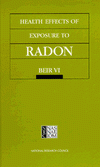
Biological Effects of Ionizing Radiations (BEIR) 6 Report: "The Health Furnishings of Exposure to Indoor Radon"
The National Enquiry Council published the report, entitled: "Health Effects of Exposure to Radon: BEIR Six, Commission on Health Risks of Exposure to Radon (BEIR VI)". This study by the National Academy of Sciences (NAS) is the most definitive accumulation of scientific data on indoor radon. The report confirms that radon is the 2nd leading cause of lung cancer in the U.S. and that information technology is a serious public health problem. The report fully supports EPA estimates that radon causes about 15,000 lung cancer deaths per year.
The ISBN number for the volume is 0-309-056454-four; National Academy Printing, 516 pages, 1999. The listed hardcover price for the book is $54.95 U.S. and $66.00 Intl. The Written report can exist read and purchased from The National Academies Press.
- Read the Executive Summary and the Public Summary
Written report: EPA's Assessment of Risks from Radon in Homes
In 2003 the Agency updated the estimates of lung cancer risks from indoor radon based on the National University of Sciences' (NAS) latest report on radon, the Biological Furnishings of Ionizing Radiations (BEIR) 6 Report (1999). EPA worked closely with the Scientific discipline Informational Board (SAB), an independent panel of scientific experts, to decide how best to utilize the risk models developed by the BEIR Vi committee. The SAB's communication and recommendations were incorporated modifying and extending the methods and approaches used in BEIR Six to construct a single model yielding results midway betwixt the results obtained using the ii models preferred by the BEIR VI committee. The Agency's updated calculation of a all-time guess of annual lung cancer deaths from radon is almost 21,000 (with an uncertainty range of 8,000 to 45,000), which is consistent with the estimates of the BEIR VI Study. A single risk model also permitted the Agency to summate a numerical estimate of the hazard per unit exposure [lung cancer deaths per working level month (WLM)] which will exist used to update estimated lung cancer risks from radon in various publications, including A Citizen's Guide to Radon.
- EPA'south Cess of Risks from Radon in Homes (June 2003, 402-R-03-003, PDF).

Former U.S. Surgeon Full general Richard H. Carmona, Releases National Health Informational on Radon
(Jan 13, 2005) U.Southward. Surgeon General, Richard H. Carmona, bug a Health Advisory warning Americans about the health gamble from exposure to radon in indoor air. The Chief Dr. urged Americans to test their homes to discover out how much radon they might be breathing.
Dr. Carmona also stressed the need to remedy the problem as soon as possible when the radon level is iv pCi/L or more, noting that more than than 20,000 Americans die of radon-related lung cancer each year.
- The Full Press Release
World Health System's International Radon Project
(2009) The World Health Organization (WHO) says radon causes upwards to 15% of lung cancers worldwide. In an effort to reduce the charge per unit of lung cancer effectually the world, the World Health Organization (WHO) launched an international radon project to help countries increase awareness, collect data and encourage activity to reduce radon-related risks.
The U.S. EPA is 1 of several government agencies and countries supporting this initiative and is encouraged past WHO's attention to this important public health issue.
"Radon poses an hands reducible health risk to populations all over the earth, but has not upwards to at present received widespread attention," said Dr. Michael Repacholi, coordinator of WHO's Radiation and Environmental Wellness Unit of measurement. He went on to say that "radon in our homes is the master source of exposure to ionizing radiation, and accounts for fifty% of the public's exposure to naturally-occurring sources of radiations in many countries."
- Visit the World Health Organization's International Radon Project site.
Radon-related Lung Cancer Deaths Compared to Other Select Cancers
The following graphic compares EPA estimates of the annual radon-related lung cancer deaths to other selected cancers. The other mortality numbers in this graphic were obtained from the National Cancer Found's 2010 Surveillance, Epidemiology, and Cease Results (SEER) estimated US mortality numbers(one pp, 15 K, About PDF).
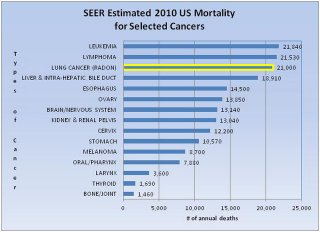
.
Webinar: An Introduction to Radon Gas in Homes
This webinar provides an overview of the primal basic facts of radon - what it is, what it does to u.s.a., how we measure it, how we reduce our exposure, and resources for additional data. )Presenters include: Bruce Snead, Manager of Engineering Extension at Kansas State Academy and director of the National Radon Program Services effort for EPA since 2009.
Source: https://www.epa.gov/radon/health-risk-radon
0 Response to "If You Had Lung Cancer What Are the Chances You Get It Again"
Post a Comment