Tunisian Chrochet Baby Afghan With Mutiple Scraps of Yarn
Crochet (;[ane] French: [kʁɔʃɛ] [2]) is a procedure of creating textiles by using a crochet claw to interlock loops of yarn, thread, or strands of other materials.[3] The name is derived from the French term crochet, pregnant 'small claw'. Hooks can be made from a diversity of materials, such as metal, forest, bamboo, or plastic. The cardinal difference between crochet and knitting, beyond the implements used for their product, is that each stitch in crochet is completed earlier the adjacent one is begun, while knitting keeps many stitches open at a time. Some variant forms of crochet, such as Tunisian crochet and broomstick lace, exercise keep multiple crochet stitches open at a time.
Sit-in of crochet technique
Etymology [edit]
The discussion crochet is derived from the Old French crochet, a diminutive of croche, in turn from the Germanic croc, both meaning "hook".[3] It was used in 17th-century French lace-making, where the term crochetage designated a stitch used to join separate pieces of lace. The word crochet subsequently came to describe both the specific type of textile, and the hooked needle used to produce information technology.[4]
Origins [edit]

19th century crochet from Orvieto, Italy
Knitted textiles survive from as early on as the 11th century CE, but the first noun show of crocheted fabric emerges in Europe during the 19th century.[5] Before work identified every bit crochet was commonly fabricated past nålebinding, a different looped yarn technique.

A crocheted purse described in 1823 in Penélopé
The showtime known published instructions for crochet explicitly using that term to draw the arts and crafts in its present sense appeared in the Dutch mag Penélopé in 1823. This includes a color plate showing five styles of pocketbook, of which three were intended to be crocheted with silk thread.[six] The first is "simple open crochet" (crochet simple ajour), a mesh of concatenation-stitch arches. The second (illustrated hither) starts in a semi-open form (demi jour), where chain-stitch arches alternate with as long segments of skid-stitch crochet, and closes with a star made with "double-crochet stitches" (dubbelde hekelsteek: double-crochet in British terminology; single-crochet in US).[7] The 3rd purse is made entirely in double-crochet. The instructions prescribe the use of a tambour needle (as illustrated beneath) and introduce a number of decorative techniques.
The earliest dated reference in English to garments made of textile produced past looping yarn with a hook—shepherd's knitting—is in The Memoirs of a Highland Lady past Elizabeth Grant (1797–1830). The journal entry, itself, is dated 1812 but was not recorded in its later published form until some time between 1845 and 1867, and the actual date of publication was get-go in 1898.[8] Nonetheless, the 1833 book of Penélopé describes and illustrates a shepherd'southward hook, and recommends its utilize for crochet with coarser yarn.[9]
In 1844, one of the numerous books discussing crochet that began to announced in the 1840s states:
Crochet needles, sometimes chosen Shepherds' hooks, are made of steel, ivory, or box-wood. They have a hook at 1 finish similar in shape to a fish-hook, by which the wool or silk is caught and drawn through the work. These instruments are to be procured of various sizes...[10]
Two years afterwards, the same writer writes:
Crochet, — a species of knitting originally practised by the peasants in Scotland, with a pocket-size hooked needle chosen a shepherd'south hook, — has, within the last seven years, aided by gustation and fashion, obtained the preference over all other ornamental works of a like nature. It derives its present name from the French; the instrument with which information technology is worked existence by them, from its crooked shape, termed 'crochet.' This art has attained its highest degree of perfection in England, whence it has been transplanted to France and Germany, and both countries, although unjustifiably, have claimed the invention.[xi]
An instruction book from 1846 describes Shepherd or single crochet as what in electric current British usage is either called unmarried crochet or skid-run up crochet, with U.S. American terminology always using the latter (reserving single crochet for use equally noted to a higher place).[12] Information technology similarly equates "Double" and "French crochet".[13]

Tambour embroidery in the Diderot Encyclopedia
Notwithstanding the categorical assertion of a purely British origin, there is solid prove of a connection between French tambour embroidery and crochet. French tambour embroidery was illustrated in item in 1763 in Diderot's Encyclopedia. The tip of the needle shown there is duplicate from that of a present-mean solar day inline crochet hook and the chain stitch separated from a material support is a key element of the latter technique. The 1823 Penélopé instructions unequivocally land that the tambour tool was used for crochet and the first of the 1840s instruction books uses the terms tambour and crochet as synonyms.[14] This equivalence is retained in the 4th edition of that work, 1847.[xv]

Shepherd's hook, 19th-century tapered hook, modern inline hook
The strong taper of the shepherd's hook eases the production of sideslip-stitch crochet merely is less amenable to stitches that require multiple loops on the hook at the same time. Early yarn hooks were also continuously tapered but gradually enough to conform multiple loops. The design with a cylindrical shaft that is commonplace today was largely reserved for tambour-manner steel needles. Both types gradually merged into the modern form that appeared toward the end of the 19th century, including both tapered and cylindrical segments, and the continuously tapered bone claw remained in industrial production until Globe War Two.
The early instruction books brand frequent reference to the alternative utilise of 'ivory, bone, or wooden hooks' and 'steel needles in a handle', every bit appropriate to the stitch existence made. Taken with the synonymous labeling of shepherd'southward- and single crochet, and the similar equivalence of French- and double crochet, there is a potent suggestion that crochet is rooted both in tambour embroidery and shepherd's knitting, leading to thread and yarn crochet respectively; a distinction that is still made. The locus of the fusion of all these elements—the "invention" noted higher up—has still to be determined, as does the origin of shepherd's knitting.
Shepherd'due south hooks are even so beingness made for local skid-stitch crochet traditions. The form in the accompanying photograph is typical for contemporary product. A longer continuously tapering blueprint intermediate between information technology and the 19th-century tapered hook was likewise in earlier production, commonly existence fabricated from the handles of forks and spoons.
Irish crochet [edit]
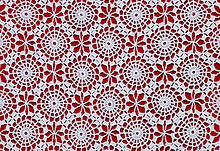
Item of a Portuguese crocheted tablecloth, virtually 1970
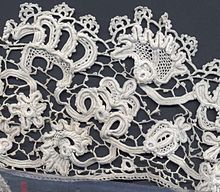
Irish gaelic crochet lace, late 19th century. The design of this example is closely based on Flemish needle lace of the 17th century.
In the 19th century, as Ireland was facing the Great Irish gaelic Famine (1845–1849), crochet lace work was introduced as a form of famine relief[16] (the production of crocheted lace being an alternative way of making money for impoverished Irish workers).[17] Men, women, children joined a cooperative in order to crochet and produce products to help with famine relief during the Great Irish Famine. Schools to teach crocheting were started. Teachers were trained and sent across Ireland to teach this craft. When the Irish gaelic immigrated to the Americas, they were able to take with them crocheting.[xviii] Mademoiselle Riego de la Branchardiere is by and large credited with the invention of Irish Crochet, publishing the first book of patterns in 1846. Irish lace became popular in Europe and America, and was made in quantity until the beginning Earth War.[19]
Modern practice and culture [edit]
Fashions in crochet changed with the end of the Victorian era in the 1890s. Crocheted laces in the new Edwardian era, peaking between 1910 and 1920, became even more elaborate in texture and complicated stitching.

The strong Victorian colours disappeared, though, and new publications called for white or pale threads, except for fancy purses, which were oftentimes crocheted of brightly colored silk and elaborately beaded. After World State of war I, far fewer crochet patterns were published, and about of them were simplified versions of the early 20th-century patterns. Afterward World War 2, from the tardily 1940s until the early 1960s, in that location was a resurgence in involvement in dwelling crafts, especially in the United states of america, with many new and imaginative crochet designs published for colorful doilies, potholders, and other home items, along with updates of before publications. These patterns chosen for thicker threads and yarns than in earlier patterns and included wonderful variegated colors. The craft remained primarily a homemaker'south art until the late 1960s and early 1970s, when the new generation picked upward on crochet and popularized granny squares, a motif worked in the round and incorporating vivid colors.

Detail on gold thread crochet in a mid-20th century short jacket designed by Sybil Connolly
Although crochet underwent a subsequent reject in popularity, the early 21st century has seen a revival of interest in handcrafts and DIY, also as great strides in improvement of the quality and varieties of yarn. There are many more new pattern books with modern patterns being printed, and virtually yarn stores now offer crochet lessons in add-on to the traditional knitting lessons. There are many books you tin can buy from local volume stores to teach yourself how to crochet whether it be as a beginner or intermediate. There are also many books for children and teenagers who are hoping to take up the hobby. Filet crochet, Tunisian crochet, tapestry crochet, broomstick lace, hairpin lace, cro-hooking, and Irish crochet are all variants of the basic crochet method.
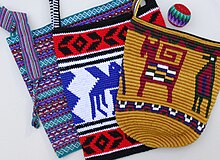
Crochet has experienced a revival on the catwalk also. Christopher Kane's Fall 2011 Set up-to-Wearable drove[20] makes intensive use of the granny square, one of the most basic of crochet motifs. In addition, crochet has been utilized many times past designers on the popular reality show Project Runway. Websites such as Etsy and Ravelry take fabricated it easier for private hobbyists to sell and distribute their patterns or projects across the internet.
Laneya Wiles released a music video titled "Straight Hookin'" which makes a play on the give-and-take "hookers," which has a double meaning for both "one who crochets" and "a prostitute."
Materials [edit]
Basic materials required for crochet are a claw and some blazon of cloth that will be crocheted, most normally yarn or thread. Yarn, 1 of the about normally used materials for crocheting, has varying weights which need to be taken into consideration when following patterns. Boosted tools are convenient for keeping stitches counted, measuring crocheted fabric, or making related accessories. Examples include cardboard cutouts, which can be used to make tassels, fringe, and many other items; a pom-pom circle, used to make pom-poms; a record mensurate and a gauge measure, both used for measuring crocheted work and counting stitches; a row counter; and occasionally plastic rings, which are used for special projects. In recent years, yarn selections accept moved beyond synthetic and constitute and animate being-based fibers to include bamboo, qiviut, hemp, and assistant stalks, to name a few. Many advanced crocheters have also incorporated recycled materials into their work in an endeavor to "go green" and experiment with new textures by using items such every bit plastic bags, old t-shirts or sheets, VCR or Cassette tape, and ribbon.
Crochet hook [edit]

The crochet claw comes in many sizes and materials, such every bit os, bamboo, aluminium, plastic, and steel. Because sizing is categorized by the bore of the hook's shaft, a crafter aims to create stitches of a certain size in order to reach a particular gauge specified in a given pattern. If judge is not reached with one hook, another is used until the stitches made are the needed size. Crafters may take a preference for ane blazon of hook textile over another due to aesthetic appeal, yarn glide, or hand disorders such as arthritis, where bamboo or forest hooks are favored over metal for the perceived warmth and flexibility during use. Hook grips and ergonomic hook handles are likewise available to assistance crafters.
Steel crochet hooks range in size from 0.4 to 3.v millimeters, or from 00 to 16 in American sizing. These hooks are used for fine crochet work such as doilies and lace.
Aluminium, bamboo, and plastic crochet hooks are available from 2.v to nineteen millimeters in size, or from B to S in American sizing.
Artisan-made hooks are oftentimes fabricated of paw-turned woods, sometimes decorated with semi-precious stones or beads.
Crochet hooks used for Tunisian crochet are elongated and have a stopper at the end of the handle, while double-ended crochet hooks take a hook on both ends of the handle. At that place is besides a double hooked appliance called a Cro-claw that has become popular.
A hairpin loom is frequently used to create lacy and long stitches, known every bit hairpin lace. While this is not in itself a hook, it is a device used in conjunction with a crochet hook to produce stitches.
See : List of United States standard crochet hook and knitting needle sizes
Yarn [edit]
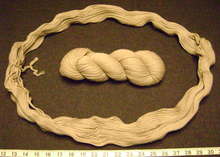
A hank of wool yarn (heart) is uncoiled into its bones loop. A tie is visible at the left; afterward untying, the hank may be wound into a ball or balls suitable for crocheting. Crocheting from a normal hank directly is likely to tangle the yarn, producing snarls.
Yarn for crochet is usually sold as assurance, or skeins (hanks), although information technology may also be wound on spools or cones. Skeins and balls are by and large sold with a yarn band, a characterization that describes the yarn's weight, length, dye lot, fiber content, washing instructions, suggested needle size, likely judge, etc. Information technology is a common practise to salvage the yarn band for future reference, especially if additional skeins must be purchased. Crocheters generally ensure that the yarn for a project comes from a single dye lot. The dye lot specifies a group of skeins that were dyed together and thus have precisely the same color; skeins from unlike dye lots, fifty-fifty if very similar in color, are usually slightly different and may produce a visible stripe when added onto existing work. If bereft yarn of a single dye lot is bought to complete a project, additional skeins of the aforementioned dye lot can sometimes be obtained from other yarn stores or online.
The thickness or weight of the yarn is a significant gene in determining how many stitches and rows are required to encompass a given surface area for a given sew pattern. This is also termed the gauge. Thicker yarns generally require large-bore crochet hooks, whereas thinner yarns may be crocheted with thick or thin hooks. Hence, thicker yarns by and large crave fewer stitches, and therefore less time, to work up a given project. The recommended judge for a given ball of yarn can be found on the label that surrounds the skein when buying in stores. Patterns and motifs are coarser with thicker yarns and produce assuming visual furnishings, whereas thinner yarns are best for refined or delicate pattern-work. Yarns are standardly grouped by thickness into 6 categories: superfine, fine, lite, medium, bulky and superbulky. Quantitatively, thickness is measured by the number of wraps per inch (WPI). The related weight per unit of measurement length is commonly measured in tex or denier.

Transformation of a hank of lavender silk yarn (tiptop) into a ball in which the yarn emerges from the center (lesser). Using the latter is improve for needlework, since the yarn is much less likely to tangle.
Before apply, hanks are wound into assurance in which the yarn emerges from the middle, making crocheting easier by preventing the yarn from becoming easily tangled. The winding procedure may be performed past hand or done with a ballwinder and swift.
A yarn's usefulness is judged past several factors, such as its loft (its power to trap air), its resilience (elasticity under tension), its washability and colorfastness, its mitt (its feel, peculiarly softness vs. scratchiness), its durability confronting abrasion, its resistance to pilling, its hairiness (fuzziness), its trend to twist or untwist, its overall weight and drape, its blocking and felting qualities, its comfort (breathability, moisture absorption, wicking properties) and its appearance, which includes its colour, sheen, smoothness and ornamental features. Other factors include allergenicity, speed of drying, resistance to chemicals, moths, and mildew, melting point and flammability, retention of static electricity, and the propensity to have dyes. Desirable properties may vary for different projects, so at that place is no i "best" yarn.

The ii possible twists of yarn
Although crochet may be washed with ribbons, metal wire or more exotic filaments, most yarns are made by spinning fibers. In spinning, the fibers are twisted so that the yarn resists breaking under tension; the twisting may be done in either direction, resulting in a Z-twist or South-twist yarn. If the fibers are first aligned by combing them and the spinner uses a worsted blazon drafting method such as the brusk forwards draw, the yarn is smoother and chosen a worsted; by contrast, if the fibers are carded but not combed and the spinner uses a woolen drafting method such as the long astern describe, the yarn is fuzzier and called woolen-spun. The fibers making up a yarn may exist continuous filament fibers such every bit silk and many synthetics, or they may exist staples (fibers of an average length, typically a few inches); naturally filament fibers are sometimes cut upwardly into staples before spinning. The forcefulness of the spun yarn against breaking is determined past the corporeality of twist, the length of the fibers and the thickness of the yarn. In general, yarns go stronger with more twist (also called worst), longer fibers and thicker yarns (more fibers); for example, thinner yarns require more twist than exercise thicker yarns to resist breaking under tension. The thickness of the yarn may vary along its length; a slub is a much thicker department in which a mass of fibers is incorporated into the yarn.
The spun fibers are generally divided into animal fibers, plant and synthetic fibers. These fiber types are chemically different, respective to proteins, carbohydrates and synthetic polymers, respectively. Animal fibers include silk, only mostly are long hairs of animals such as sheep (wool), goat (angora, or cashmere goat), rabbit (angora), llama, alpaca, dog, cat, camel, yak, and muskox (qiviut). Plants used for fibers include cotton, flax (for linen), bamboo, ramie, hemp, jute, nettle, raffia, yucca, coconut husk, banana trees, soy and corn. Rayon and acetate fibers are also produced from cellulose mainly derived from copse. Mutual synthetic fibers include acrylics,[21] polyesters such as dacron and ingeo, nylon and other polyamides, and olefins such as polypropylene. Of these types, wool is generally favored for crochet, chiefly attributable to its superior elasticity, warmth and (sometimes) felting; withal, wool is mostly less convenient to clean and some people are allergic to it. It is also common to blend different fibers in the yarn, e.g., 85% alpaca and 15% silk. Even inside a type of fiber, at that place tin exist great diverseness in the length and thickness of the fibers; for example, Merino wool and Egyptian cotton are favored because they produce exceptionally long, thin (fine) fibers for their type.
A single spun yarn may exist crochet every bit is, or braided or plied with another. In plying, two or more yarns are spun together, almost always in the opposite sense from which they were spun individually; for example, two Z-twist yarns are commonly plied with an S-twist. The opposing twist relieves some of the yarns' tendency to gyre up and produces a thicker, balanced yarn. Plied yarns may themselves be plied together, producing cabled yarns or multi-stranded yarns. Sometimes, the yarns beingness plied are fed at different rates, and then that one yarn loops effectually the other, as in bouclé. The single yarns may be dyed separately before plying, or afterwards to give the yarn a compatible look.
The dyeing of yarns is a complex art. Yarns need non be dyed; or they may be dyed one color, or a swell multifariousness of colors. Dyeing may be done industrially, past paw or even mitt-painted onto the yarn. A swell variety of synthetic dyes take been developed since the synthesis of indigo dye in the mid-19th century; however, natural dyes are also possible, although they are generally less brilliant. The color-scheme of a yarn is sometimes called its colorway. Variegated yarns can produce interesting visual effects, such as diagonal stripes.
Procedure [edit]
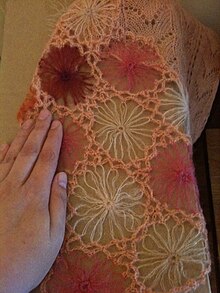
A shut view of a crocheted scarf made with lace-weight mohair yarn.
Crocheted fabric is begun past placing a slip-knot loop on the hook (though other methods, such every bit a magic band or simple folding over of the yarn may exist used), pulling another loop through the first loop, and repeating this procedure to create a chain of a suitable length. The chain is either turned and worked in rows, or joined to the beginning of the row with a slip stitch and worked in rounds. Rounds can also be created past working many stitches into a single loop. Stitches are fabricated by pulling one or more loops through each loop of the chain. At any i time at the end of a stitch, there is only one loop left on the hook. Tunisian crochet, however, draws all of the loops for an entire row onto a long hook before working them off ane at a fourth dimension. Like knitting, crochet can exist worked either flat (dorsum and along in rows) or in the round (in spirals, such as when making tubular pieces).
Types of stitches [edit]
At that place are six primary types of basic stitches (the following clarification uses US crochet terminology which differs from the terminology used in the UK and Europe).
- Concatenation stitch – the almost basic of all stitches and used to begin most projects.
- Slip stitch – used to join chain sew to form a ring.
- Single crochet stitch (called double crochet stitch in the UK) – easiest stitch to master (come across unmarried crochet sew together tutorial)
- One-half-double crochet stitch (called half treble stitch in the UK) – the 'in-between' sew (see half-double crochet tutorial)
- Double crochet stitch (called treble sew in the UK) (yarn over once) – many uses for this unlimited use stitch (see double crochet run up tutorial)
- Treble (or triple) crochet stitch (chosen double treble stitch in the Britain) (yarn over twice)
While the horizontal distance covered by these bones stitches is the aforementioned, they differ in height and thickness.
The more avant-garde stitches are frequently combinations of these bones stitches, or are made by inserting the hook into the work in unusual locations. More advanced stitches include the shell stitch, V sew together, fasten stitch, Afghan stitch, butterfly run up, popcorn stitch, cluster stitch, and crocodile stitch.
International crochet terms and notations [edit]

Some crochet symbols, abbreviations, and US/UK terms
In the English language-speaking crochet globe, basic stitches have different names that vary by country. The differences are usually referred to as United kingdom of great britain and northern ireland/United states or British/American. Crochet is traditionally worked off a written pattern in which stitches and placement are communicated using textual abbreviations.[22] To help counter confusion when reading patterns, a diagramming system using a standard international annotation has come into utilise (illustration, left). In the United states of america, crochet terminology and sizing guidelines, also equally standards for yarn and hook labeling, are primarily regulated by the Craft Yarn Quango.[23]
Another terminological difference is known as tension (UK) and approximate (United states of america). Private crocheters piece of work yarn with a loose or a tight agree and, if unmeasured, these differences can lead to significant size changes in finished garments that have the same number of stitches. In society to control for this inconsistency, printed crochet instructions include a standard for the number of stitches beyond a standard swatch of textile. An private crocheter begins work by producing a exam swatch and compensating for whatever discrepancy by changing to a smaller or larger hook. North Americans call this gauge, referring to the result of these adjustments; British crocheters speak of tension, which refers to the crafter's grip on the yarn while producing stitches.
Differences from and similarities to knitting [edit]
One of the more than obvious differences is that crochet uses i hook while much knitting uses ii needles. In almost crochet, the artisan usually has simply one live sew together on the hook (with the exception existence Tunisian crochet), while a knitter keeps an unabridged row of stitches active simultaneously. Dropped stitches, which can unravel a knitted fabric, rarely interfere with crochet work, due to a second structural difference between knitting and crochet. In knitting, each stitch is supported past the respective stitch in the row to a higher place and it supports the corresponding stitch in the row below, whereas crochet stitches are only supported by and support the stitches on either side of it. If a stitch in a finished crocheted particular breaks, the stitches above and below remain intact, and because of the circuitous looping of each stitch, the stitches on either side are unlikely to come up loose unless heavily stressed.
Round or cylindrical patterns are elementary to produce with a regular crochet hook, but cylindrical knitting requires either a ready of round needles or 3 to 5 special double-ended needles. Many crocheted items are composed of private motifs which are then joined, either past sewing or crocheting, whereas knitting is usually composed of one material, such as entrelac.
Freeform crochet is a technique that can create interesting shapes in three dimensions because new stitches tin be made independently of previous stitches almost anywhere in the crocheted slice. Information technology is generally accomplished by building shapes or structural elements onto existing crocheted fabric at any place the crafter desires.
Knitting can be accomplished by car, while many crochet stitches can only exist crafted by hand. The height of knitted and crocheted stitches is likewise different: a single crochet stitch is twice the height of a knit sew in the same yarn size and comparable diameter tools, and a double crochet stitch is about four times the peak of a knit stitch.[24]
While most crochet is made with a hook, there is also a method of crocheting with a knitting loom. This is called loomchet.[25] Slip sew crochet is very similar to knitting. Each run up in slip sew together crochet is formed the aforementioned way as a knit or purl stitch which is and then bound off. A person working in slip stitch crochet can follow a knitted pattern with knits, purls, and cables, and get a similar upshot.[26]
Information technology is a common perception that crochet produces a thicker fabric than knitting, tends to have less "give" than knitted material, and uses approximately a tertiary more yarn for a comparable project than knitted items. Although this is true when comparison a single crochet swatch with a stockinette swatch, both made with the same size yarn and needle/claw, it is non necessarily true for crochet in general. Most crochet uses far less than 1/3 more yarn than knitting for comparable pieces, and a crocheter can get similar feel and pall to knitting by using a larger hook or thinner yarn. Tunisian crochet and sideslip sew together crochet can in some cases use less yarn than knitting for comparable pieces. Co-ordinate to sources[27] claiming to take tested the 1/3 more yarn assertion, a single crochet stitch (sc) uses approximately the same corporeality of yarn equally knit garter stitch, only more yarn than stockinette stitch. Any stitch using yarnovers uses less yarn than single crochet to produce the same amount of fabric. Cluster stitches, which are in fact multiple stitches worked together, volition use the well-nigh length.
Standard crochet stitches similar sc and dc also produce a thicker fabric, more like knit garter stitch. This is part of why they utilise more yarn. Slip stitch tin produce a material much like stockinette that is thinner and therefore uses less yarn.
Whatsoever yarn can be either knitted or crocheted, provided needles or hooks of the correct size are used, simply the cord'due south properties should exist taken into account. For example, lofty, thick woolen yarns tend to function improve when knitted, which does not beat out their airy structure, while thin and tightly spun yarn helps to achieve the firm texture required for Amigurumi crochet.[28]
- Differences betwixt crochet and knitting
-

Most crochet uses one claw and works upon one stitch at a time. Crochet may be worked in circular rounds without any specialized tools, equally shown here.
-

Knitting uses two or more than straight needles that conduct multiple stitches.
-

Dissimilar crochet, knitting requires specialized needles to create circular rounds.
Charity and activism [edit]
It has been very mutual for people and groups to crochet article of clothing and other garments and then donate them to soldiers during state of war. People have also crocheted wear and and then donated it to hospitals, for sick patients and also for newborn babies. Sometimes groups will crochet for a specific charity purpose, such as crocheting for homeless shelters, nursing homes, etc.
It is becoming increasingly popular to crochet hats (commonly referred to as "chemo caps") and donate them to cancer treatment centers, for those undergoing chemotherapy and therefore losing hair. During October pink hats and scarves are fabricated and gain are donated to chest cancer funds. Organizations defended to using crochet as a way to assist others include Knots of Honey, Crochet for Cancer,[29] and Soldiers' Angels.[thirty] These organizations offer warm useful items for people in demand.
In 2020, people around the world banded together to assistance salvage the wildlife affected by the Australian bushfires by crocheting kangaroo pouches, koala mittens and wildlife nests.[31] This was an international effort to help during the particularly bad bushfire season which devastated local ecological systems.
A group started in 2005 to create crochet versions of coral reefs grew by 2022 to over 20,000 contributors in what became the Crochet Coral Reef Projection.[32] To promote awareness of the furnishings of global warming, their creations have been displayed in galleries and museums by an estimated 2 million people.[32] Many creations employ hyperbolic (curved) geometric shapes—distinguished from Euclidian (apartment) geometry—to emulate natural structures.[32]
Health benefits [edit]
Crocheting and other forms of needlecraft or handicraft are proven to accept several health benefits including reducing stress and anxiety.[33] Studies show that the constant repetition of hand movement helps keep the listen at-home and distracts the encephalon from the stresses of life.[34] When crocheting, the brain releases serotonin that helps calm the mind and improve mood.[34] Crocheting and similar activities are shown to improve Alzheimer'southward affliction, indisposition, and low.[33] The colors and textures of the yarn are usually pleasing to the senses, and the finished product can give a person a sense of accomplishment.[34]
Mathematics and hyperbolic crochet [edit]
Crochet has been used to illustrate shapes in hyperbolic space that are difficult to reproduce using other media or are difficult to understand when viewed ii-dimensionally.[35]
Mathematician Daina Taimiņa first used crochet in 1997 to create strong, durable models of hyperbolic space after finding newspaper models were delicate and difficult to create. These models enable one to turn, fold, and otherwise manipulate space to more than fully grasp ideas such as how a line can appear curved in hyperbolic infinite yet really be directly. Her work received an exhibition past the Establish For Figuring.[35]

A drove of crocheted hyperbolic planes, in faux of a coral reef.
Examples in nature of organisms that show hyperbolic structures include lettuces, sea slugs, flatworms and coral. Margaret Wertheim and Christine Wertheim of the Institute For Figuring created a travelling art installation of a coral reef using Taimina's method. Local artists are encouraged to create their ain "satellite reefs" to be included alongside the original display.[36]
As hyperbolic and mathematics-based crochet has continued to become more popular, there have been several events highlighting work from various fiber artists. Two such shows include Sant Ocean Hall at the Smithsonian in Washington D.C. and Sticks, Hooks, and the Mobius: Knit and Crochet Become Cognitive at Lafayette College in Pennsylvania.
Compages [edit]
In Manner in the technical arts, Gottfried Semper looks at the textile with great promise and historical precedent. In Section 53, he writes of the "loop stitch, or Noeud Coulant: a knot that, if untied, causes the whole organisation to unravel." In the aforementioned section, Semper confesses his ignorance of the subject of crochet simply believes strongly that it is a technique of smashing value as a cloth technique and perchance something more.
At that place are a small number of architects currently interested in the subject of crochet as information technology relates to compages. The following publications, explorations and thesis projects tin be used equally a resource to come across how crochet is being used inside the capacity of compages.
- Emergent Explorations: Analog and Digital Scripting - Alexander Worden
- Inquiry and Design: The Architecture of variation - Lars Spuybroek
- YurtAlert - Kate Pokorny
Yarn bombing [edit]
In the past few years, a practice called yarn bombing, or the use of knitted or crocheted cloth to modify and beautify one's (usually outdoor) environment, emerged in the US and spread worldwide.[37] Yarn bombers sometimes target existing pieces of graffiti for adornment. In 2010, an entity dubbed "the Midnight Knitter" hitting West Cape May. Residents awoke to find knit cozies hugging tree branches and sign poles.[38] In September 2015, Grace Brett was named "The World's Oldest Yarn Bomber". She is part of a group of yarn graffiti-artists chosen the Souter Stormers, who beautify their local boondocks in Scotland.[39]
Styles in Crochet [edit]
- Mosaic Crochet
- Granny foursquare
- Freeform Crochet
- Motifs
- Crocheted lace
- Tunisian Crochet
- Tapestry Crochet
- Amigurumi
- Filet Crochet
- Corner to Corner (C2C) Crochet
See as well [edit]
- Crochet Guild of America
- The Tempestry Project
- Fiber art
- Macramé
- Knitting
References [edit]
- ^ "crochet". Dictionary.reference.com. Retrieved 2012-04-28 .
- ^ "crochet". Wordreference.com. Retrieved 2012-04-28 .
- ^ a b "Crochet". The Free Dictionary By Farlex. Retrieved 2012-05-23 .
- ^ Santina M. Levey, Lace: a History, Victoria & Albert Museum, London, 1983, ISBN 090128615X, p. 92
- ^ Lis Paludan, Crochet: History & Technique, Interweave Press, Loveland CO, ISBN 1883010098, p. 76
- ^ [1] A. B. Van Meerten, Penélopé, of, Maandwerk aan het vrouwelijk geslacht toegewijd, Amsterdam, 1824, pp. 90-94
- ^ Sarah Hazell, 200 Crochet Stitches, Search Press, Kent, 2013, ISBN 978-ane-84448-963-3
- ^ [ii] Elizabeth Grant, The Memoirs of a Highland Lady, John Murray, London, 1898 p. 182.
- ^ [iii] A. B. Van Meerten, Penélopé, of, Maandwerk aan het vrouwelijk geslacht toegewijd, Amsterdam, 1833, pp. 152
- ^ [4] Miss Lambert, Hand-book of Needlework, New York City, 1842, p.92
- ^ [5] Miss Lambert, My Crochet Sampler, London, 1844, pp. 9-10
- ^ Nancy Nehring, Acquire Slip Stitch Crochet, Annie's Attic, Berne IN, 2008, ISBN 1596352159, p. 2
- ^ [vi] Mlle. Riego de la Branchardiere, Knitting, Crochet, and Netting, London, 1846, p.57
- ^ [7] Mrs. Gaugain, The Lady'southward Assistant for Executing Useful and Fancy Designs in Knitting, Netting and Crotchet Work, Edinburgh, 1840
- ^ [8] Jane Gaugain, The Lady'south Assistant for Executing Useful and Fancy Designs in Knitting, Netting and Crochet Work, fourth ed., 1847
- ^ "Crochet | arts and crafts". Encyclopedia Britannica.
- ^ Irish Crochet Lace Exhibit Catalog Archived 2010-06-01 at the Wayback Machine Lacis Museum of Lace and Textiles. 2005.
- ^ "Crochet History - Crochet Social club of America (CGOA)". world wide web.crochet.org . Retrieved 2017-01-22 .
- ^ Art That Saved the Irish From Starvation past Zelda Bronstein. Berkeley Daily Planet, April 19, 2005.
- ^ "Sac en toile de jute et cabas courses à personnaliser en sérigraphie". artipack.fr.
- ^ Masson, James (1995). Acrylic Fiber Engineering and Applications. New York: Marcel Dekker, Inc. p. 172. ISBN0-8247-8977-6.
- ^ "Crochet Abbreviations Master List". Craft Yarn Quango . Retrieved sixteen October 2018.
- ^ "Standards and Guidelines for Crochet and Knitting". Craft Yarn Council. Archived from the original on 2018-04-07. Retrieved 22 October 2021.
- ^ Hubert, Margaret (2009). Knit Or Crochet - Have It Your Fashion . Minneapolis, MN: Creative Publishing International, Inc. p. 6. ISBN978-1-58923-431-4.
- ^ Brenda GA, Dome-Dweller. "Loom Lore: March 2010". Loomlady.blogspot.com. Retrieved 2012-04-28 .
- ^ "Slip Sew Crochet « A Yarnified Life". Ayarnifiedlife.wordpress.com. 29 March 2011. Retrieved 2012-04-28 .
- ^ "Crochet does non apply 1/3 more yarn than knitting". Crochetliberationfront.com. 2012-02-20. Archived from the original on 2012-02-24. Retrieved 2012-04-28 .
- ^ "Southern Belle Lulu design by S. Pendleton". Ravelry.
- ^ "Crochet for Cancer". Crochet for Cancer . Retrieved 9 February 2018.
- ^ "Soldiers' Angels-Sewing and Crafting Team". Soldiers' Angels . Retrieved nine February 2018.
- ^ "Calling all crafters! Here's how you can assistance wild animals afflicted by the Australia wildfires". wbir.com. viii Jan 2020. Retrieved 2020-ten-07 .
- ^ a b c Burack, Cristina (30 January 2022). "Crocheted ocean art to fight global warming". Deutsche Welt. Archived from the original on 31 January 2022.
- ^ a b "seven Surprising Wellness Benefits of Crocheting". AllFreeCrochet.com. 2017-01-20. Retrieved 2019-04-14 .
- ^ a b c Houtman, Betty (2017-10-eleven). "How Crochet and Knitting Help the Brain". Feet Resource Center . Retrieved 2019-04-14 .
- ^ a b "Hyperbolic Space". The Institute for Figuring. December 21, 2006. Retrieved January 15, 2007.
- ^ "About the Projection | Crochet Coral Reef". www.crochetcoralreef.org . Retrieved 2017-10-30 .
- ^ Anonymous (2009-01-21). "Knitters plow to graffiti artists with 'yarnbombing'". The Telegraph . Retrieved 2009-05-25 .
- ^ "'Midnight Knitter' covers West Cape May copse, lamp poles with yarn". NJ.com. 10 March 2010. Retrieved 5 Feb 2014.
- ^ Shah, Yagana (September 25, 2015). "104-Year-Erstwhile 'Yarn Bomber' Spreads Her 'Graffiti' All Over Boondocks". HuffPost.
Further reading [edit]
- Karen Manthey; Susan Brittain; Julie Armstrong Holetz (2010). Crocheting for Dummies (paperback) (2nd ed.). Hoboken, NJ: Wiley. ISBN978-0-470-53645-2.
- Hadley, Sara. "Irish gaelic Crochet Lace", The Lace Maker, Vol. 4 iii, New York: D.S. Bennet, 1911.
- Kooler, Donna Donna Kooler's Encyclopedia of Crochet, Leisure Arts, Inc., Little Rock, Arkansas
- Lambert, Miss [Frances]. My Crochet Sampler, London: John Murray, Albemarle Street, 1844.
- Potter, Annie Louise. A living mystery: the international art & history of crochet
- Riego de la Branchardiere, Eléanor. Crochet Book quaternary Series, London: Simpkin, Marshall, and Co., 1848.
- Riego de la Branchardiere, Eléanor. Crochet Book sixth Serial, containing D'Oyleys and Anti-Macassars, London: Simpkin, Marshall, and Co., 1877. This is the 20th printing of this volume; the original publishing date is probably about 1850.
- Riego de la Branchardiere, Eléanor. Crochet Book, 9th Serial or Tertiary Winter Book, London: Simpkin, Marshall and Co., 1850.
- Warren, The Courtroom Crochet Doyley Book, London: Ackermann & Co, 1847.
- Wildman, Emily. Step-Past-Step Crochet, 1972
External links [edit]
 | Wikimedia Commons has media related to Crochet. |
- Yarn Weight Yarn weight to crochet claw size guide
- The Antique Pattern Library
- Virtual Museum of Cloth Arts Ancient Crochet Lace
Source: https://en.wikipedia.org/wiki/Crochet
0 Response to "Tunisian Chrochet Baby Afghan With Mutiple Scraps of Yarn"
Post a Comment