what happens to real estate in a recession
Every bit we circular the corner to the final half of 2020, the U.s. continues to fight against the spread of the coronavirus. Unemployment rates are at all-fourth dimension highs and the economy is knocking on the door of a recession.
Because nosotros've experienced many recessions in the past, nosotros have a pretty good understanding of what to expect – by and large. However, as nosotros've seen with the inflow of the novel coronavirus, the causes and effects of one recession compared to another can vary greatly.
A recession is when the overall economic system in a specific surface area experiences a significant turn down. By definition, recessions hateful at least two quarters of economic shrinkage. A recession turns into a depression if the economy continues to decline for multiple years.
In that location are several cardinal economic factors of recessions. The health of the economy is based on the operation of i) gross domestic product (Gross domestic product), 2) personal income, iii) employment, 4) manufacturing, and 5) retail sales. While no one indicator is entirely dependent on another, when ane gets wobbly it can crusade a domino effect causing the other indicators to do the same.
Recessions can cause unemployment rates to skyrocket and personal incomes to subtract. Naturally, this puts even more financial pressure on many homeowners and renters, as we've seen since the COVID-19 outbreak.
As nosotros begin to adapt to our "new normal," information technology'south of import to understand what to wait from existent estate during the recession at hand. What happens to existent manor in a recession? How practice rents and habitation values typically movement in recessions, and will rents and home prices get downwardly in 2020?
What Happens to Existent Manor in a Recession?
When the overall economy is suffering, more people lose their jobs which cause some to pull out of the business firm hunting game. In by recessions, nosotros've seen sure markets experience a driblet in demand for homes and a rise in supply. When this happens, home prices volition typically dip, adjusting to market weather. But not all recessions are the aforementioned, and this one is definitely different than any other nosotros've seen in history. Permit's take a wait at how real manor has been affected thus far.
What Happens to Real Manor Values in a Recession?
We know that recessions tin can be caused by a diversity of factors and terminal for varying periods of fourth dimension.
Many of u.s. call up the most recent recession caused by a mortgage meltdown, the Great Recession. This particular recession greatly impacted the value of homes. In fact, the 2008 recession was really centered around the real manor industry, and fifty-fifty acquired by it.
Loose lending practices immune more people to qualify for homes, driving home prices upward to inflated levels. Easy lending likewise allowed more than builders to create more inventory, flooding the market with new homes. When adaptable rate mortgages reset to a higher charge per unit in 2006 and 2007, many borrowers were unable to brand the new payment. Mortgage defaults started to soar, as people who had put no money downwards on their homes just walked abroad from the new, higher payments.
The real manor market shortly became inundated with overpriced, empty homes that eventually were taken back by the banks. The housing bubble popped, and home prices came crashing down. The Great Recession lasted over two years and forced millions of people to become renters, as they lost their homes to foreclosure.
The Bang-up Recession is unique because it was triggered past easy lending standards, including no down payment requirements, depression or no documentation requirements, and qualification based on a teaser rate versus the actual rate – on both chief and investment properties. Literally anyone could qualify for a mortgage, whether they could afford it or not. It should accept been no surprise that that business firm of cards would eventually fall.
Notwithstanding, non all recessions are caused by loose lending. In the '70s, it was acquired by the oil embargo. In the eighty'due south, information technology was caused past junk bonds. In the '90s, it was oil again. And in the early 2000's it was speculation in the tech industry. These recessions didn't always have an impact on the value of homes, and if they did, it was marketplace specific. In fact, in several by recessions, the price of homes really went upward.
Brian'southward Notation: Take a look at median US home prices since the '60s, with recessions highlighted in gray:

Habitation values volition probable decline in some markets during a recession, but non ever. Home prices were also less impacted during recessions that didn't final every bit long.
What Happens to Rents in a Recession?
Rents can go both up and downward in a recession. The location of a rental holding and how difficult the local economy is hit by a recession volition dictate whether rents become up, down or stay the same.
For example, a working-class housing market that experiences huge job losses during a recession will likely come across an increase in vacancies, forcing rents down. This happened in N Dakota in 2015 when oil prices plunged, every bit the economic system in N Dakota was highly dependent on high oil prices.
On the other hand, if a property is located in a less vulnerable surface area and/or occupied by a tenant with more than resources, rents may by and large stay the same during a recession.
Houston, Texas serves as a peachy case of this. Even though oil prices plunged in 2015, home prices increased in Houston, mainly because the metro area has a various economy that is no longer reliant primarily on oil production.
Brian's Note: Rents tend to remain more than resilient than property values in a recession. At worst, nationwide rents tend to flatten out during recessions – meet this chart:
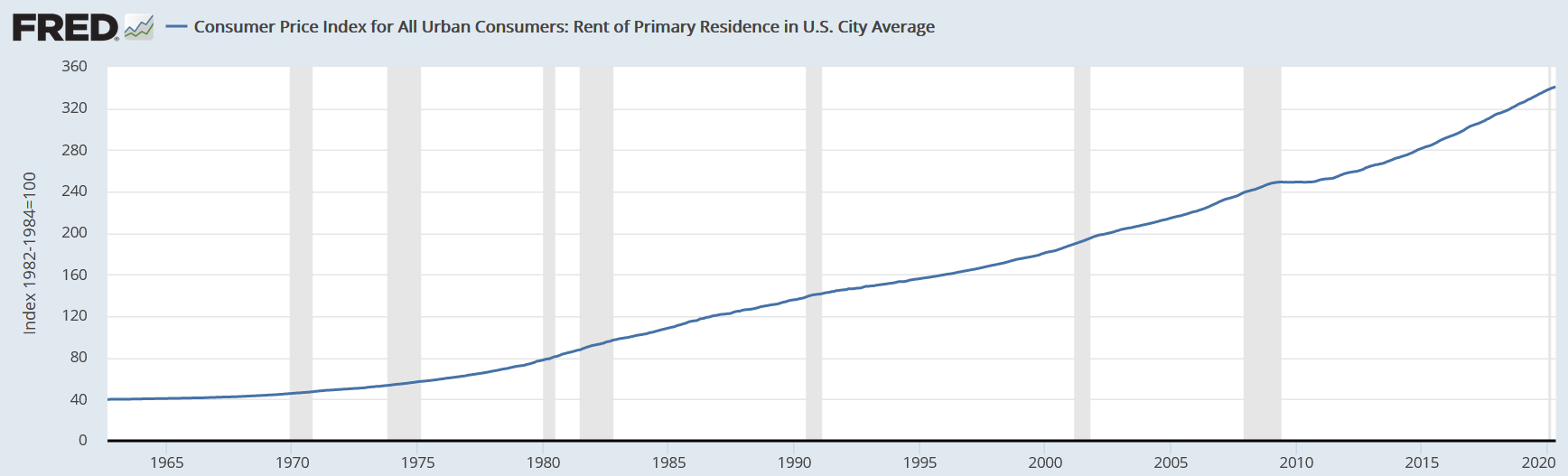
But every bit Kathy points out, nationwide averages can conceal some markets rising while other markets autumn in recessions.
What'southward Happening to Existent Estate Right Now?
The biggest crisis in real estate today is not vacancies or delinquencies. Information technology's a lack of supply. There doesn't seem to be an stop in sight to the affordable housing shortage across in the U.Southward. In many cities, income is not keeping up with increasing rents or home prices, calculation even more financial strain to renters and home buyers.
According to the State of the Nation'due south 2019 Housing Market place report by Harvard University, 50 per centum of renters spend more than 30 percent of their monthly income on rent. Which eliminates a large portion of people that tin't beget to keep up with rising rents.
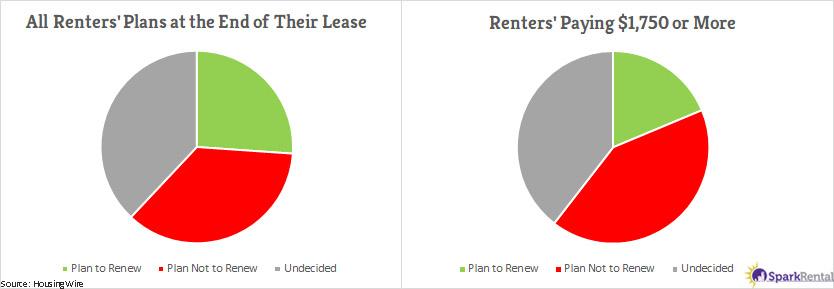
And sure enough, nosotros're seeing more tenants planning to non-renew college rent charter agreements than more affordable rentals. See this data from HousingWire:
To solve this issue, more affordable low-income and center-income housing needs to be built to meet the demand of buyers and renters. Unfortunately, building costs accept increased substantially over the years, making it most impossible for builders to provide affordable housing. Most of the new inventory that has been built over the past decade has been on the higher end, as information technology'southward the only way for builders to make a profit.
COVID-xix has caused major slowdowns in both manufacturing and structure, which is further exacerbating the problem. Some builders have stopped building entirely, while others have slowed down essentially. According to the US Demography Bureau, in April and May, in that location were fewer building permits issued, housing starts and completions, compared to a year agone. This tendency tells us that this lack of supply may go along for the foreseeable hereafter.
Will Rents Go Down This Year?
Apartment rents in some areas around the land have started to decrease, simply only slightly. March through June is ordinarily the busiest flavour for rental activity, only with the Coronavirus shutting down the economy during those months, many people just stayed put.
However, single family unit rental rates have stayed consequent and fifty-fifty increased in some areas. There is a new de-urbanization trend emerging of people moving out of the cities and into the suburbs, in search of more space in order to practice meliorate social distancing.
According to a contempo report by Flat Listing, the national rent index fell by 0.3 percent from March to June. To put this seemingly nominal number into perspective, since 2014 rents grew between 1.0 percent and 1.7 percent (from March to June). This "Pandemic Pricing" shows united states of america how COVID-19 has impacted people financially and fifty-fifty shifted what renters may now be looking for in a place to alive.
The cities with the largest decline in rent prices fall into two categories:
- Expensive markets with already high pre-pandemic rents.
- Markets where the local economic system relies heavily on service and tourism sectors.
The following 10 cities are experiencing the biggest drops in rent, while the suburbs are gaining speed:
- San Francisco, CA
- Orlando, FL
- New York, NY
- San Jose, CA
- Miami, FL
- Charlotte, NC
- Austin TX
- Houston, TX
- Washington, DC
- Tampa, FL
At a national level, we have yet to see pregnant drops in rent since the pandemic began. Merely certain markets that were highly impacted past shelter-in-place orders are seeing a more than rapid decline in rents – especially in big, expensive metros where virtually people lived in condos or apartments. Today, many of the desirable amenities that attracted residents are at present closed – including pond pools, gyms and fifty-fifty restaurants.
Will Domicile Prices Get Downwards This Year?
Information technology'southward all the same hard to say whether habitation prices will go downwardly this year as markets will be affected differently. The COVID-19 outbreak and subsequent "shut-downwards" slowed real estate activity for a cursory time, mainly due to a lack of inventory as more than people stayed put and few people wanted strangers walking through their homes.
Even though home sales declined for this reason, habitation prices held relatively steady. "Safer at home" guidelines have elevated the domicile to a whole new level of importance, along with a new gear up of needs – like home offices, better kitchens, and a yard for outdoor privacy.
In April and May, we began seeing existing habitation sales decline nationwide. There were 17% fewer existing homes sold in April 2020 compared to a twelvemonth agone. In May, the number of existing home sales dropped 26.vi percentage, year-over-twelvemonth.
Even with the recent drop in home sales, the sales cost of existing single-family homes is yet holding upwardly, particularly in the Northeast (up ix.ii% year-over-year). In May, the NAR reported that the average price of single-family homes nationwide went upwardly two.4 percent compared to 2019.
The pandemic has slowed price gains in certain regions around the land, which is really a positive outcome for homebuyers struggling to afford a abode. Low interest rates likewise help. However, the lack of affordable, low-to-mid-priced homes, coupled with loftier demand is driving abode prices upwards in some areas.
We are already seeing a leveling out or drop in markets where household incomes have failed to proceed pace with the increasing price of homes. The question is, which markets will meet the demand for affordable housing?
The shortage of affordable housing has translated to a shortage of affordable rental housing as well, all the while, rental demand remains strong. This is proficient news for real manor investors.
Should Y'all Purchase a Home During a Recession?
In the past, recessions tin bring a buyer's marketplace. In a buyer's market, there will be less competition and more houses on the marketplace. Buyer's bear the power and are less probable to compete with multiple offers. Depending on the market and your resources, a recession may be a bang-up time to invest in existent estate, specially if rents continue to rising. Fifty-fifty if home prices stay steady, there may be some opportunity to find motivated sellers and distressed backdrop at a discount.
Additionally, it's important to note that some industries actually thrive during recessions or remain relatively unaffected. In today'south environment, economies based on healthcare, biotech or loftier-tech are booming. Real estate markets may well hold stiff in these "recession-proof" areas.
And finally, follow is the money supply as a disquisitional metric. In the past several months, over $3 trillion dollars have been created by the Federal Reserve to buy bonds and to proceed the banks solvent. When these funds broadcast, asset prices tend to increment as more dollars chase a limited supply of goods (read: inflation). Generally, real estate and stock prices increase when the money supply increases, making them great hedges against inflation. We accept never seen a monetary stimulus quite like this, so I practise expect to see inflation in real estate and stocks over the coming years, even while unemployment is high. Unfortunately for renters, this also ways rents will likely increase, and the affordable housing crisis will continue.
Real estate can be a safe haven for investors during tough economic times. Depending on your goals and tolerance for take a chance, recession-busting investments can protect your coin, grow your money or do both. It is our mission at RealWealth to assist as many people as we can acquire recession-proof and inflation-proof avails during these uncertain times.
What are your thoughts on existent estate investing in a recession? Are y'all planning to build your rental portfolio, or stay on the sidelines to see what happens?
Larn More, Earn More:
Source: https://sparkrental.com/real-estate-in-recessions/
0 Response to "what happens to real estate in a recession"
Post a Comment